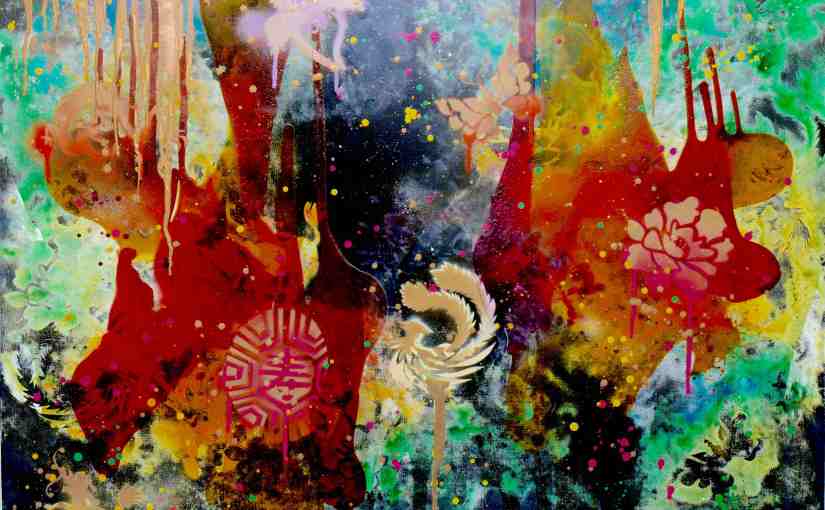
(Above: Cosmic Culture by Herman Salleh, 2009, mixed media on canvas, 153 cm x 122 cm)
Cosmic Culture, Herman Salleh
Born in Singapore in 1983, Herman is an artist and gallerist living and working in Singapore. He graduated from LASALLE College of the Arts with a BA (Honours) in Fine Arts in 2009. Herman’s relationship with visual art has been taking various forms over time, reflecting his diverse interests and experience as an educator, artist and a gallerist. As a visual artist with a passion for art and design, he created art that is very vibrant and exciting. Since 2014, Herman has assisted as a part-time lecturer in his alma-mater. In 2012, Herman followed his long-term interest in the arts business and ran a Singapore-based Japanese Art Gallery specializing in contemporary art from Japan, Asia and Europe.
This striking painting was part of a project where the Peranakan Association collaborated with young Singaporean artists to understand and appreciate the role of traditional culture in a dynamic modern country, and to create awareness about its history and the origins in the region. “Cosmic Culture” is executed in a unique technique combining layers of paint, resin and spray paint, creating a material, almost 3-dimensional representation of a dream where the ancient and the modern urban cultures coexist. In a harmonious space, centuries-old symbols of the Butterfly and the Peony are floating freely in the stardust above the night sky, and the Phoenix is reborn to the bright neon lights of the big city.
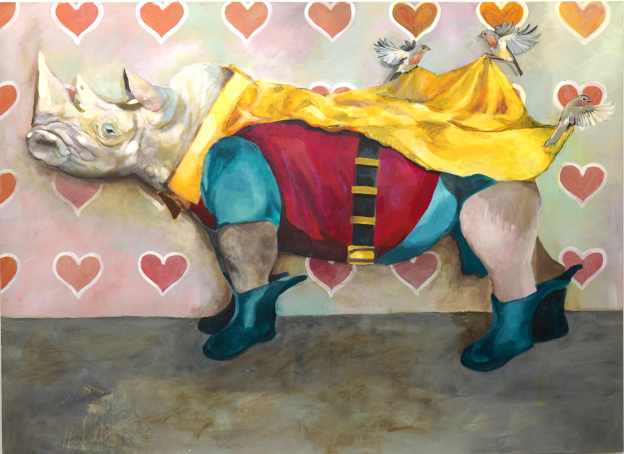
Here Comes the Bride, Khairullah Rahim
Khairullah Rahim (b.1987, Singapore) graduated with a Bachelor of Fine Arts (Painting) from LASALLE College of the Arts, Singapore (2013). He was also a recipient of the Future Leader Scholarship from the college. He has participated in various group exhibitions including CRUISE, Chan Hampe Galleries, Singapore (2015), No Approval, Grey Projects, Singapore (2013), and PROJECT 6581, Japan Creative Centre – Embassy of Japan, Singapore (2013). In 2013 he was invited to extend his research and practice during an artist-in-residence programme organised by YOUKOBO Art Residency Programme, Japan and INSTINC Gallery, Singapore. He is currently a part-time lecturer at LASALLE College of the Arts.
Formally trained in the field of painting, Khairullah has also explored other media such as sculpture, installation, and video in developing his practice. In his works, he creates engaging and sometimes challenging stories of the marginalization of minorities, among other social issues in Singapore, which are often contextual analogies for human societies. Both factual events and personal experiences are fundamental in his works as he mixes fact and fiction to compelling and convincing effect, thus creating a discourse. However, while he guards their inaccessible nature, he also testifies to the eroticism, sensuality, and life present in these contexts and characters.
Interested in the idea of the “second fiddle”, in his earlier series of paintings Khairullah used mainly animals to convey this idea. In “Here comes the bride” (2009), he compared the idea of the elephant and the rhinoceros to the popular Batman and Robin duo in the context of the animal kingdom. The idea of the supporting role has often taken a back seat to the leading role, when in reality the success of the leading role may be highly dependent on the sidekick’s contribution. In the artists’ opinion, the rhinoceros is usually seen upon as more passive compared to the elephant and to a certain extent, even unimportant. You may say that his paintings from this early series were like a stand in for a self-portrait.
Layers of Blessings, Mardiana Jamaludin, 2009, acrylic on canvas, 127 cm x 101 cm
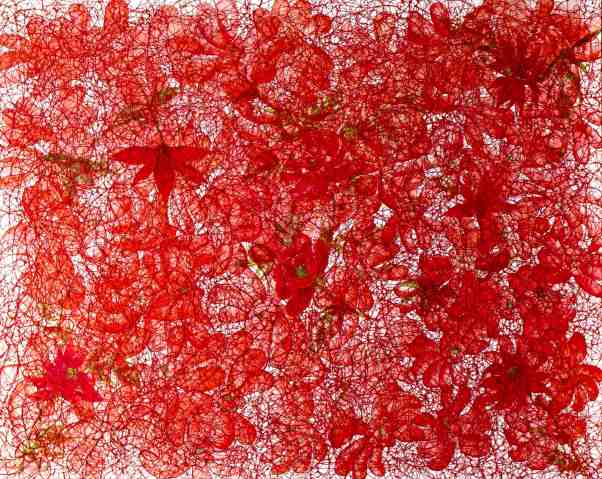
Layers of Blessings, Mardiana Jamaludin
Mardiana Jamaludin (b.1986) has always believed that painting is the channel to express her deep emotions and thoughts. After obtaining a scholarship, she pursued this conviction and graduated from LASALLE College of the Arts with a Bachelor in Fine Arts in 2009. Since then, Mardiana, with a genuine interest in developing a new generation of artists, has been teaching art at Kuo Chuan Presbyterian Secondary School in Singapore. She recently picked up her paintbrush again and hopes to launch her new exhibition soon.
The young Singaporean artist has always been interested in the idea of “abstracting blessings”. Her conceptual intention is to immortalise the initially ephemeral blessings by portraying and perpetuating them on her canvas. In “Layers of Blessings” (2009), the motif of layering symbolises the abundant blessings the artist has collected over the years, the expansion of gratitude, and her hope for life itself. Heavily influenced by the culture of Henna markings, Mardiana employed a special technique using thin layers of acrylic on canvas, which results in these beautiful patterns representing a web of blissful blessings. The work was exhibited in the LASALLE Graduation show and Baba Art – Peranakan Festival in 2009.
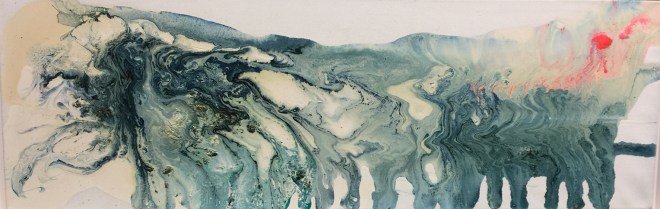
Time-based Study, Ruben Pang
Ruben Pang was born in 1990 in Singapore. After graduating from LASALLE College of the Arts in 2010 with a Diploma in Fine Art he received the Winston Oh Travelogue Award (2010), the Georgette Chen Arts Scholarship (2009-2010), the LASALLE Award for Academic Excellence, and was a finalist in the Sovereign Asian Art Prize in 2010 and 2011. His most recent solo show in Singapore was A Totem For Your Genuine Internals, Chan Hampe Galleries (2017), and his recent international solo shows include Zwitterion, Primo Marella Gallery, Milan, Italy (2016), Transfiguration, START and the Tiroche DeLeon Collection, Tel Aviv-Yafo, Israel (2015) and Aetheric Portraiture with Primae Noctis Art Gallery in Lugano, Switzerland (2013). In total, Ruben has participated in over 15 group shows locally and internationally, including The Figure in Process, From De Kooning to Kapoor, Paul Allen Brain Institute, Seattle, United States (2015) and Deep SEA, Primo Marella Gallery, Milan, Italy (2012). Locally, he has exhibited and performed in the Singapore Art Museum, LASALLE College of the Arts’ Praxis and Project Space, The Substation, and Chan Hampe Galleries.
Ruben’s vibrant and ethereal work combines fluid technique with a kaleidoscopic palette. Without a preconceived image of the final composition, Pang’s artistic process evolves throughout the painting’s genesis, removing the boundary between abstraction and representation. This approach allows the motif to surface spontaneously, which Pang describes as “visual syncopation, like searching for a melody in white noise”. Using oil paint and alkyd resin, the artist paints, scratches and erases his paintings using brushes, hands, palette knives and sandpaper, revealing layers of colour that reflect the projections of his psyche. Pang works on aluminium panels, which allow him greater freedom to transform the image as it develops. His work explores medium and method, creating a feeling of dynamism while testing the boundaries of colour, form and transparency.
Ruben says about this work: “Time-based Study is a part of a project where I dealt with the element of time as a variable in the creation of the work, also one of the first instances of approaching painting in a more process-driven way. Although the medium I used was slightly different, I could see in hindsight that I was also experimenting with the surface tension that I am still very much obsessed over now. The alkyd medium was already introduced into my work. Enamel was very fast drying and the pigments I used to create an interference were bound in both oils and enamel in order to cure with a greater degree of flexibility. I was also very fascinated with the works of Cy Twombly and Paul Jenkins at the time. I thought Cy Twombly’s surfaces felt more like walls than canvases, and that perhaps he aged them on purpose. I bought the white enamels that were old stock from the hardware shops, looking for the cans that were starting to yellow, and hoped that it would create that similar worn effect, so that you could see the distinction between the canvas white and the white of the enamel paint. I remember these pieces were done in a series of 10, and the size was chosen because they resembled MIDI notes in music production, I wanted to see if they would work together as a series simply consolidated by size – it did not work out at that point of time, each painting needed a lot of space to breathe and in my eyes could never be part of a modular system.”
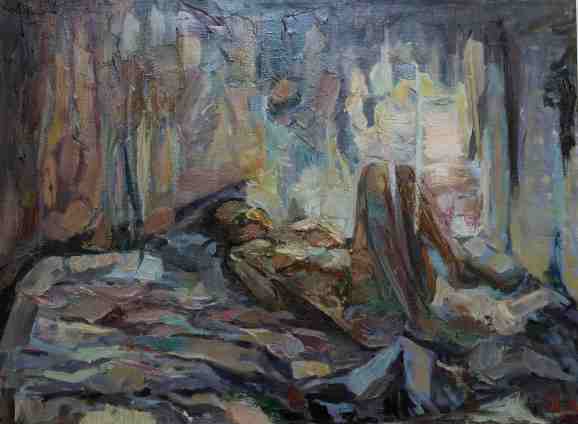
Purple Affection, Ava Tan
Born in 1984 in Shan Dong province, Ava Tan (Tan Lei) first came to encounter art through the traditional masters, and since then has fallen in love with painting. In 2005 she decided to pursue her passion for painting in Singapore, and obtained scholarships from the Ministry of Education and LASALLE College of the Arts. In 2009, Ava graduated from LASALLE with a Bachelor of Fine Arts (Painting) Degree. Ava has participated in group exhibitions including Pictures (2008), Asia Young Artist Group Show, One East Asia Gallery, Singapore (2011). Her solo shows in Singapore include Red man Green girl, One East Asia Gallery (2010), Ava Tan In Da House, Holland Village, Catherine’s house (2010), where she presented her paintings executed in her signature heavy-handed style and inspired by the red light district of Singapore. In 2011, she became the first artist in Amara Sanctuary Resort Sentosa’s Artist-In-Residence program, which culminated in a solo exhibition Naked is Beautiful, where Ava continued her explorations of women and the fetishisation of the female body. In 2012, Ava had a solo exhibition Fetish and Body, at LASALLE’s TRI-SPACE.
“Purple Affection” (2011) exemplifies the strength and vulnerability of humanity as expressed in the artist’s powerful brushstrokes and gloomy dark pigments. Ava notes that her work explores an “inward turning world that appears incongruent from the workings of a sensing body. Through a voyeuristic glass that is turned upon the skin trade and its various participants, it is at once a sympathetic and disparate view of an amorphous body image when the lines between performance and reality are blurred in the eyes of others as they are turned in upon oneself.” The artwork is part of the series Naked is Beautiful, created during Ava’s time as Artist-In-Residence at Amara Sanctuary Resort Sentosa.
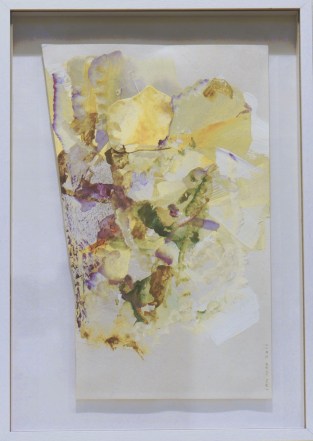
The Mirrored Sun, Ian Woo
Born in Singapore in 1967, Ian Woo is an artist working in the language of abstraction. Influenced by forms of modernism, perceptual abstraction and the sound structures of music improvisation, his work is characterized by a sense of gravitational and representational change. He often uses the term ‘picture making’ when describing his position and approach, maintaining the discipline and evolvement of painting as a vehicle for pictorial reflectivity.
Woo began his studies at the Nanyang Academy of Fine Arts (Singapore) in 1991. He received a Masters in European Fine Art at the Winchester School of Art (UK) in 1995 and a research practice DFA with RMIT University (Australia) in 2006. In 1999, Woo was the recipient of the UOB Painting of the Year award in the Abstract category. He was also the Juror’s Choice for two consecutive years in South East Asia’s Philip Morris Award in 1999 and 2000.
Recent solo exhibitions include Falling Off Plastic Chairs, Tomio Koyama Gallery Singapore (2015), The Difference Between Your Mountain and My Couch, Tomio Koyama Gallery, Japan (2014). Selected recent group exhibitions include Siapa Nama Kamu, National Gallery Singapore (2015), After Utopia, Singapore Art Museum (2015), The Origin of Beauty: Dramatic Nostalgia, Busan Museum of Art, Korea (2014) and Market Forces – Erasure: From Conceptualism to Abstraction, Osage Gallery, Hong Kong (2014). His works are in the collection of major institutions such as ABN AMRO, Singapore Art Museum, The Istana Singapore, The National Gallery Singapore, UBS, and the Mint Museum of Craft & Design, USA.
“The Mirrored Sun” is a work on paper using elements of fragmentation influenced by the sensation of colour and form. The work is characterized by a feeling of change and floating quality. Amoebic forms appear within the development of the painting where aspects matter and space interweave within the improvised lines and tectonic invention. Here painting is seen as a form of rhythmic thinking.
If you’d like to make a bid for one of the paintings, please email: artofwillinghearts@gmail.com.
 Art of the Willing Hearts